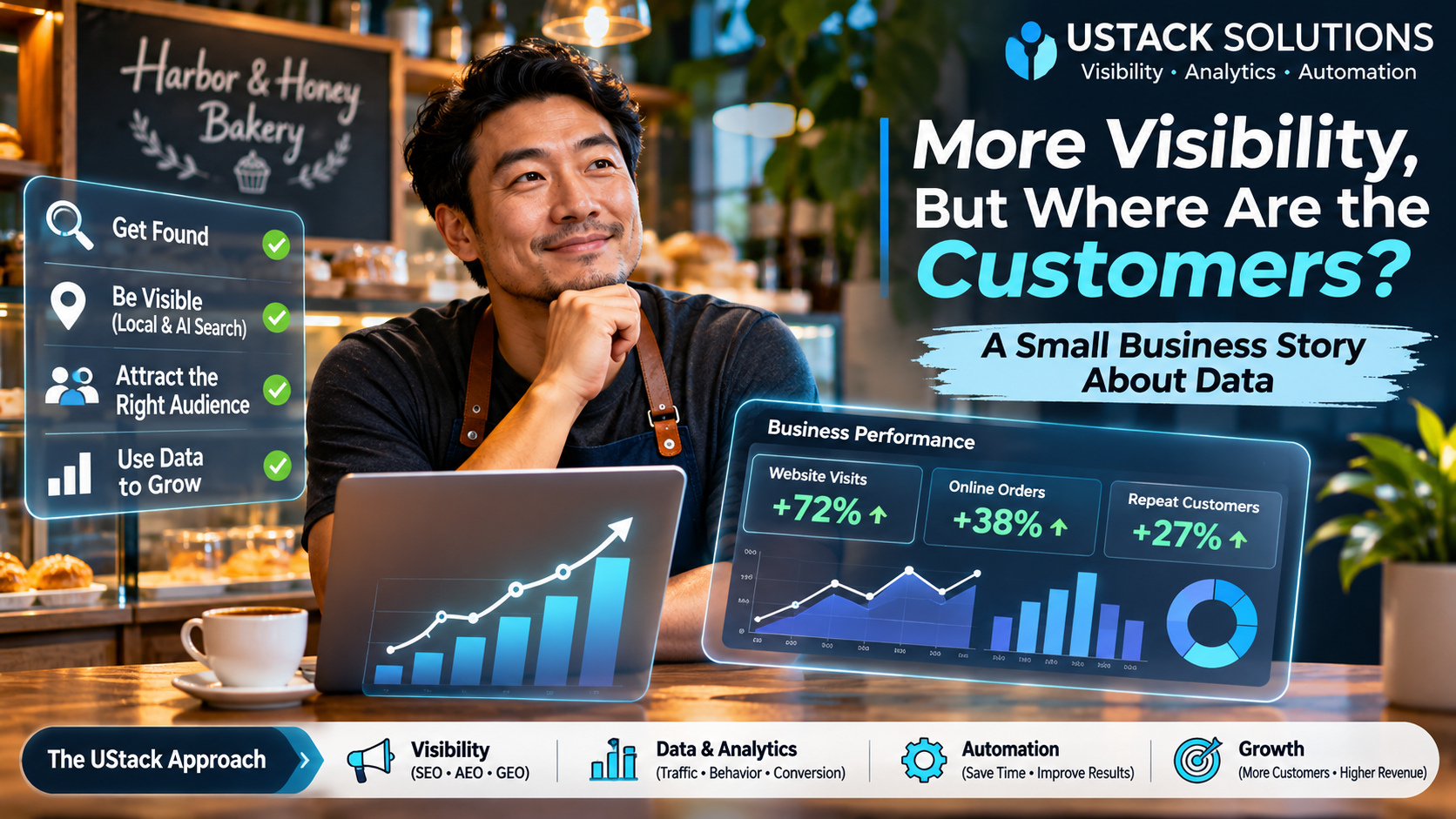
A fictional small-business story illustrating how visibility and analytics work together.
Imagine a neighborhood bakery called Harbor & Honey. After years of relying on regulars and word of mouth, its owner, Maya, decides it’s time for more people to discover the business online.
She updates the website, starts publishing helpful posts, improves her business listings, and shares new photos on social media. Soon, website traffic begins to rise. People are finding her bakery. That’s good news—until Maya asks a harder question:
“If more people can see us, why aren’t we seeing more orders?”
Visibility is the beginning, not the whole strategy
Online visibility helps a business become discoverable through search engines, maps, content, and increasingly AI-powered answers. But a visitor finding a business isn’t the same as that visitor becoming a customer.
Maya’s traffic report shows a promising increase in visits. It doesn’t immediately tell her whether those visitors are looking for birthday cakes, checking hours, comparing prices, or searching for catering. And it doesn’t explain why many visitors leave without placing an order.
Data turns attention into useful questions
Instead of posting more content and hoping for the best, Maya starts investigating. She brings together the information she can legitimately access from her website, analytics tools, search performance reports, and order records.
- Discovery: Which searches, pages, or channels bring people to the bakery?
- Interest: Which products and services attract the most attention?
- Experience: Where do visitors abandon the order or inquiry process?
- Outcome: Which sources lead to inquiries, bookings, or purchases?
- Consistency: Are the bakery’s hours, offerings, and prices represented accurately across its website and online discovery channels?
For example, she notices that the custom-cake page attracts visits but few inquiries. The page has attractive photos, yet its pricing guidance is hard to find and the order form is cumbersome on mobile devices. That’s a hypothesis worth testing, not proof that either issue caused the low conversion rate.
Maya simplifies the inquiry form, makes ordering information clearer, and compares results over time. Now she has a process for learning—not just a list of marketing activities.
What changes when visibility and analytics work together?
Visibility tells a business where it can be found. Analytics helps explain what happens next. Together, they support a practical cycle:
- Be discoverable. Make important business information clear and accessible.
- Measure. Track relevant search, website, and customer outcomes.
- Investigate. Identify patterns, gaps, and possible explanations.
- Improve. Prioritize changes based on evidence and business value.
- Verify. Check whether results improve, and continue learning.
This approach can also help businesses prepare for AI-driven discovery. An AI assistant may describe a company or recommend its services, but businesses still need ways to assess whether that information is accurate and whether attention translates into meaningful customer action.
The UStack Solutions perspective
At UStack Solutions, we believe visibility should work alongside data analytics, reporting, and thoughtful automation—not as an isolated marketing checkbox. The goal is to help businesses ask better questions, prioritize opportunities, and make informed decisions.
You don’t always need more traffic. Sometimes you need a clearer picture of the traffic you already have.
Want to understand how your business is being discovered—and what your data might be telling you? Explore our visibility and analytics services at UStack Solutions.